Breast Implants for Reconstruction: Where Motiva Fits
A board-certified Austin plastic surgeon on what Motiva and other breast implants actually mean for reconstruction — and why augmentation data doesn't necessarily transfer to a post-mastectomy breast.

Written by Brian P. Kelley, MD — Dual Board-Certified Plastic & Hand Surgeon, Austin, Texas
Affiliate Faculty, Dell Medical School at The University of Texas at Austin
Seton Ascension Institute for Reconstructive Plastic and Hand Surgery — Austin, Texas
Medically reviewed: June 4, 2026 · Last updated: June 4, 2026
Educational content. Not a substitute for individualized medical evaluation.
Introduction
If you are researching breast implants before or after a mastectomy, you have likely run into glossy claims about Motiva and other brands. Almost all of those numbers come from cosmetic augmentation, not reconstruction. They are not the same operation, and the difference shapes your result far more than the brand on the box.
I am a dual board-certified plastic and hand surgeon in Austin who focuses on breast reconstruction, including microvascular and oncologic cases. My aim here is straightforward: explain what the implant data actually shows, separate augmentation marketing from reconstruction reality, and describe how implant choice changes across staged, hybrid, and direct-to-implant reconstruction.
This page covers where Motiva currently fits, why a reconstructed breast behaves differently than an augmented one, how radiation and chemotherapy change the calculus, and how I work through implant selection with patients here in Central Texas.
Is Motiva Approved for Breast Reconstruction?
This is worth stating clearly, because many pages online do not. As of June 2026, Motiva is FDA-approved for breast augmentation only. The manufacturer submitted a reconstruction application to the FDA in December 2025, and reconstruction remains an investigational use in the United States until that review is complete.
That distinction is not a technicality. The augmentation approval rests on cosmetic patients with healthy breast tissue. Approval for reconstruction requires separate data in mastectomy patients, whose tissue conditions are entirely different. When you see a practice page presenting Motiva as a reconstruction option, ask whether they are describing approved use or investigational use.
I mention this first because accuracy is the whole point of a consultation. You deserve to know exactly what is established, what is pending, and what is still being studied before you decide.
Why Reconstruction Is Not Augmentation
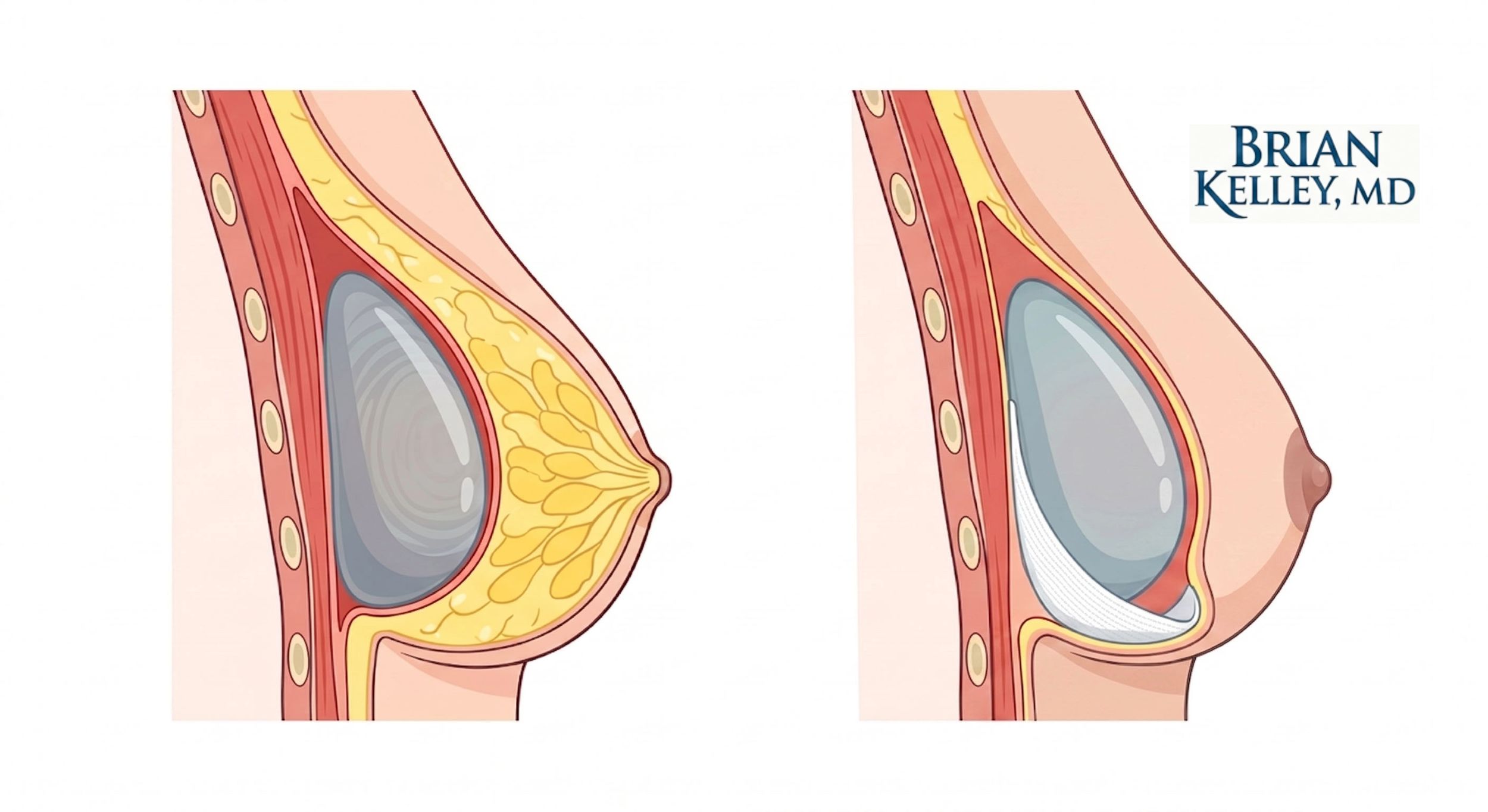
This is the most important section on the page. A cosmetic augmentation places an implant beneath a healthy breast and muscle. Reconstruction places an implant into a chest that has just lost its breast, often under a thin, bruised mastectomy skin flap with an uncertain blood supply.
That difference drives complication rates up sharply. Poorly vascularized mastectomy flaps can thin, blister, or die over an implant, risking exposure. There is little native soft tissue left to camouflage rippling or to buffer the implant from the skin. None of those pressures exist in a routine augmentation.
Radiation is the single biggest factor. Radiated tissue becomes stiff, poorly elastic, and prone to scar contracture. In implant reconstruction, contracture and failure rates climb several-fold with radiation, a relationship I examined directly in two systematic reviews of reconstruction outcomes before and after radiotherapy (PMID 24081801; PMID 24473643).
Chemotherapy and endocrine therapy add their own risks by impairing healing and, in microvascular cases, raising complication rates (PMID 21987043). The takeaway is direct: an implant's cosmetic-augmentation record tells you very little about how it will perform under a radiated, thinly covered reconstruction.
What the Motiva Data Actually Shows
Motiva is a silicone gel implant with a low-texture "SmoothSilk" surface, classified in the smooth range by international standards. In the U.S. augmentation trial, three-year capsular contracture and rupture rates were each under one percent (Glicksman 2024), and independent augmentation series report similarly low contracture rates (PMID 37254824).
Those are genuinely good augmentation numbers. The honest caveat is that they are augmentation numbers, gathered over a few years, in patients with intact breast tissue. The reconstruction evidence for Motiva is far thinner. The largest reported reconstruction series, from a single surgeon outside the U.S., found low short-term contracture rates, but with limited follow-up (PMID 37023600).
On lymphoma risk, smooth-surface implants like Motiva carry a much lower BIA-ALCL signal than the older aggressively textured implants that were withdrawn from the market. That is a real advantage, but it is a property shared by smooth implants generally, not unique to one brand.
Implant Choice Across Reconstruction Types
Reconstruction is not one operation, and the implant decision shifts with the approach.
Staged (tissue expander to implant). A temporary expander is placed first, the skin is stretched over weeks, and a permanent implant follows. This is my most common pathway when skin coverage is uncertain or radiation is planned. It lets the tissue declare itself before a final implant goes in, lowering the risk of early loss.
Direct-to-implant (DTI). A permanent implant is placed at the time of mastectomy, usually with acellular dermal matrix support, in a single stage. DTI works well when mastectomy flaps are robust and well-perfused, and it is increasingly done in the pre-pectoral plane to spare the muscle. It is less forgiving when the skin envelope is marginal.
Hybrid reconstruction. Here an implant is combined with your own tissue, such as a latissimus flap, to add durable, vascularized coverage. This is often the right answer for radiated chests, where added soft tissue protects the implant and improves the long-term result.
Across all three, capsular contracture in reconstruction is reported far above augmentation levels, frequently in the double digits and higher after radiation. Implant brand is one variable among many, and usually not the dominant one.
My Approach in Austin: Informed, Individualized Choice
In my Austin practice, I have historically used Allergan smooth implants and smooth tissue expanders for staged reconstruction. That preference reflects a long, consistent track record with these devices in reconstructive patients and the substantial long-term core-study data behind smooth silicone implants (PMID 24867717).
That said, no two patients are the same, and this is your body and your decision. For patients who are interested in Motiva or other brands, I discuss the candid risks and benefits, including the limited reconstruction-specific data and current investigational status, so the choice is made through genuine informed consent rather than marketing.
I also do not work in isolation. At The Institute for Reconstructive Plastic Surgery at Ascension Seton, reconstruction is coordinated with your breast surgeon and oncology team across Central Texas, so the implant plan fits your overall cancer treatment rather than competing with it.
Is There a "Best" Implant for Reconstruction?
Patients reasonably search for the best implant for breast reconstruction or the best implant to avoid capsular contracture. The honest answer is that there is no universal best. The implant that performs beautifully in a healthy augmentation is not necessarily the one that holds up under a radiated, poorly covered reconstruction.
What actually moves your outcome is the combination of decisions: the reconstruction type, the implant plane, whether you need radiation, the quality of your mastectomy flaps, and how much soft-tissue coverage you have. A well-chosen implant in the wrong plan underperforms a thoughtfully matched implant in the right one.
This is why patient-reported outcomes matter as much as complication tables. Long-term satisfaction data for silicone implants in reconstruction, including validated quality-of-life measures, consistently show that durable coverage and a stable result drive satisfaction more than brand (PMID 37563756). Sensation and the feel of the reconstructed breast also shape how patients judge their result over time (PMID 38461623).
Risk Factors for Capsular Contracture After Reconstruction
The factors most associated with capsular contracture in implant reconstruction include:
- Radiation to the chest, before or after reconstruction, which is the strongest single risk factor.
- Thin or poorly vascularized mastectomy skin flaps, which raise the risk of healing problems and contracture.
- Infection or biofilm around the implant, including subclinical contamination at surgery.
- Subpectoral placement in radiated patients, which several studies associate with higher contracture than pre-pectoral placement.
- Hematoma or seroma, which can trigger an inflammatory capsule.
- Loss of soft-tissue coverage, leaving the implant poorly buffered against the skin.
Related Topics
- Breast Reconstruction Overview
- Implant-based breast reconstruction
- Further information on breast reconstruction with implants
- Direct-to-Implant breast reconstruction
- Autologous vs Implant-based breast reconstruction
- Autologous fat grafting
- Breast sensation after mastectomy.
- DIEP flap breast reconstruction
- Breast Reconstruction & Radiation: Choosing a Durable Option
- Not a DIEP Candidate? Alternative Breast Reconstruction Flaps
- Revising a Breast Reconstruction Done in the Past: What's Possible?
- Breast Reconstruction Coverage in Texas: WHCRA & Beyond
Frequently Asked Questions
Not yet. As of June 2026, Motiva is approved for augmentation. A reconstruction application was submitted to the FDA in December 2025, and reconstruction remains an investigational use until that review concludes.
Those rates come from cosmetic augmentation, where contracture is uncommon. Reconstruction has higher baseline complication rates, especially with radiation, so augmentation figures should not be applied directly to a reconstructed breast. The short answer is that with more data and long-term follow-up there might be an improvement in rates, but there also might not... so, maybe.
There is no single best implant for radiation (radiation and breast reconstruction). Many patients facing radiation do better with added vascularized tissue, such as a hybrid or autologous reconstruction, than with any implant alone. This is a core part of my consultation.
For patients that only want an implant, capsular contracture is a huge risk in this population and a primary reason for reconstruction failure. In this select, unique population extra consideration of these risks may warrant extra effort to prevent these late complications of implant-based reconstruction.
On BIA-ALCL, a rare lymphoma linked mainly to aggressively textured implants, smooth-surface devices carry a much lower population risk. This is a class advantage shared by smooth implants, not unique to any one brand.
We discuss it. I have historically used Allergan smooth implants and smooth expanders in reconstruction, but am open to any new technology. Together, in consultation, we review the full risks, benefits, and the limits of the reconstruction data so you can make an informed choice.
- Momoh AO, Ahmed R, Kelley BP, et al. A systematic review of complications of implant-based breast reconstruction with pre-reconstruction and post-reconstruction radiotherapy. Ann Surg Oncol. 2014;21(1):118-124. PMID 2408180
- Kelley BP, Ahmed R, Kidwell KM, Kozlow JH, Chung KC, Momoh AO. A systematic review of morbidity associated with autologous breast reconstruction before and after exposure to radiotherapy. Ann Surg Oncol. 2014. PMID 24473643
- Kelley BP, Yi M, Valero V, Kronowitz S. Tamoxifen increases the risk of microvascular flap complications in patients undergoing microvascular breast reconstruction. Plast Reconstr Surg. 2012;129(2):305-314. PMID 21987043
- Schafer HA, Leathers KO, et al. Toward breast reinnervation — what is our endpoint: a systematic review of normal breast sensibility. J Plast Reconstr Aesthet Surg. 2024;91:383-398. PMID 38461623
- Glicksman C, Wolfe A, McGuire P. Safety and effectiveness of Motiva SmoothSilk silicone gel-filled breast implants: three-year clinical data. Aesthet Surg J. 2024;44(12):1273-1285. doi:10.1093/asj/sjae134
- Single surgeon's experience with Motiva Ergonomix round SilkSurface silicone implants in breast reconstruction over a 5-year period. J Plast Reconstr Aesthet Surg. 2023. PMID 37023600
- Capsular contracture rate in augmentation mammoplasty with Motiva breast implant insertion: a single-center experience in Korea. Aesthet Surg J. 2023;43(11):1248-1255. PMID 37254824
- Safety and efficacy of the Sientra silicone gel round and shaped breast implants: 6-year results of the U.S. postapproval study. Plast Reconstr Surg. 2024. PMID 37563756
- Spear SL, et al. Natrelle round silicone breast implants: Core Study results at 10 years. Plast Reconstr Surg. 2014. PMID 24867717
Disclaimer
This article is for educational purposes and reflects general information about breast reconstruction and breast implants. It is not medical advice and does not establish a physician-patient relationship. Implant approvals, indications, and data change over time. Decisions about reconstruction and implant selection should be made through an individualized consultation that accounts for your diagnosis, treatment plan, and personal goals.



Want to learn more?
Book a consultation